September 15 update: Laurel deserves answers - the public comment and supporting records.
5 Lies You're Being Told About the Facility in Laurel
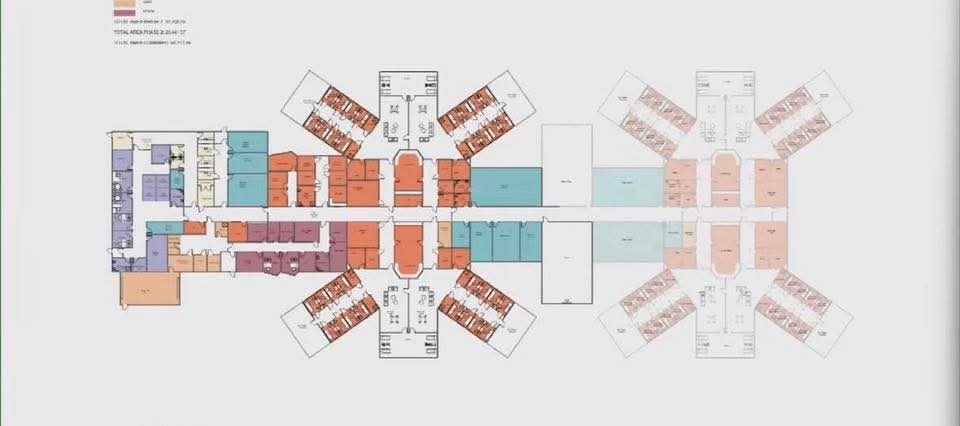
The facility floor plan presented at the April 22 BOI meeting where the Montana Board of Investments voted YES at 9:30 AM in Helena to increase the project's budget to $48 million - before most Laurel residents had even spoken at the public comment session. The state has told residents this is a 32-bed facility. This plan shows 70+ beds.
My previous post used satire to describe the April 22nd public comment session. Some people found that uncomfortable. Fair enough - so let me take this opportunity to set aside the jokes and lay out, plainly and factually, what Laurel residents are not being told about this facility. If the truth reads as harsh, that's not a problem with how it's being delivered.
Lie #1: "It's a Mental Health Facility"
This is the foundational deception - the one that makes every other lie possible.
I say this as someone who recovered in Laurel. Deb Perrigo was my counselor. I'm sober today because of work I did here - and that is exactly why the state's conflation of criminal sentencing with behavioral health treatment upsets me personally.
When the state calls this a "behavioral health facility," they are exploiting a legal technicality that most Montanans don't know exists. Here's the context you need:
Montana abolished the insanity defense in 1979. Montana is one of only four states in the country - along with Kansas, Idaho, and Utah - that does not allow a defendant to be found "Not Guilty by Reason of Insanity" (NGRI). That defense does not exist here.
In its place, Montana created the Guilty But Mentally Ill (GBMI) verdict.
GBMI is not a mental health outcome. It is a criminal conviction. A GBMI defendant is found guilty, sentenced as guilty, and carries a criminal record. The only difference from a standard guilty verdict is that their sentence is served under DPHHS custody rather than the Department of Corrections - which is the entire reason the state gets to call the facility that houses them a "mental health facility."
In states with a real insanity defense, people found NGRI are committed to psychiatric hospitals and cannot be released until they are deemed no longer dangerous. There is no fixed sentence. Public safety is the release condition.
Montana's GBMI system works nothing like that. These are convicted criminals serving fixed criminal sentences - and the facility proposed for Laurel will house them.
The phrase "behavioral health facility" is the state's chosen language for a building full of people a court found guilty of crimes. That choice is not accidental.
Lie #2: "These Are Patients"
The word "patient" implies someone who sought treatment, or who is being held for their own welfare. It implies a hospital. It implies care.
The people who will be housed in this facility are not patients in that sense. They are individuals who have been convicted of crimes and sentenced to serve that sentence at a DPHHS facility, or individuals whose freedoms have been removed by a court order pending criminal proceedings.
At Montana's existing Forensic Mental Health Facility in Galen, 27 of the 53 forensic beds are currently occupied by GBMI-sentenced individuals. The state's own documents describe this population as "nearly static." These are not people rotating through for brief evaluations. They are convicted criminals serving out their sentences - the same sentences they would carry if the word "mentally ill" had never entered the courtroom.
The crimes that produce GBMI verdicts are serious crimes. Montana does not hand GBMI verdicts to people who shoplifted. These are felony cases - homicides, assaults, sexual offenses - in which the defendant's mental illness was relevant but not sufficient to avoid conviction.
Calling them "patients" asks you to picture someone receiving treatment who might need your compassion. That framing is not wrong exactly - mental illness is real and these individuals do have it. But it is strategically incomplete. The full picture is a convicted felon, serving a criminal sentence, housed in a building 459 yards from your child's school.
Lie #3: "They'll Be Held as Long as They're Dangerous"
This is perhaps the most consequential thing Laurel residents don't know.
In states with a true insanity defense, NGRI acquittees are committed until they are no longer dangerous. There is no release date. Public safety governs the timeline.
Montana's GBMI system has none of that.
Because GBMI is a criminal sentence - not a civil commitment - the legal framework that governs it is the same framework that governs any other criminal sentence. When the sentence expires, the legal obligation ends.
When a GBMI inmate's sentence is up, they are released. There is no automatic psychiatric hold. No mandatory mental health review. No civil commitment proceeding. No danger assessment required before the door opens. Montana law restores all civil rights upon sentence expiration.
The state can pursue a separate civil commitment under MCA Title 53-21 if someone presents an imminent danger - but that requires an entirely new legal proceeding, with its own burden of proof, initiated by someone who chooses to file it. It is not automatic. It does not always happen.
It gets worse. Under MCA 46-23-201, GBMI individuals are eligible for parole after serving just one-fourth of their sentence - the same standard as any other convicted person. The Board of Pardons and Parole may require participation in a supervised mental health treatment program as a condition of parole - but it is not mandatory. There is no published data on whether parolees actually receive managed conditional release plans.
This means the facility proposed for Laurel will house convicted felons who can be paroled into our community after serving a quarter of their sentence - or released outright when their sentence concludes. Either way, there is no requirement that they are no longer dangerous. No mandatory mental health review. No danger assessment before the door opens.
Some Laurel residents have been told that individuals will only be released into the community if Laurel is their hometown. That is not how sentence expiration works. When the sentence ends, the person walks out the door of the facility they are housed in. That facility is in Laurel.
Laurel residents were never told this. The state's "behavioral health" framing implies a hospital model where people leave when they're well. The reality is a criminal sentence model where people leave when the clock runs out - or sooner.
Lie #4: "The Community Was Consulted"
On the morning of April 22, 2026, Laurel residents were invited to the public library to speak their concerns into a microphone at a conference table staffed by a DPHHS attorney and a Board of Investments attorney. Residents came. They spoke. They described their fears about the location, the proximity to West Elementary, and the lack of transparency in the site selection process. The attorneys listened. Notes were taken.
Simultaneously, in Helena, the Montana Board of Investments convened and voted to approve Contract BOI SH-DM-1-2026 - a $48,296,810.40 project management agreement with D&M Development, LLC to design, construct, and supervise the facility at the Laurel site.
The contract is backdated to January 1, 2026. It is stamped "DRAFT."
The residents speaking in Laurel were not informed that a $48 million construction contract was being approved at the exact moment they were being heard.
The BOI has refused to acknowledge the timing. No spokesperson has addressed why a $48 million construction contract was approved at the exact moment residents were being invited to share their concerns. No one has explained why the Laurel session was scheduled to coincide with the Helena vote. No one has been asked to.
The effect - intentional or not - is that Laurel residents could not easily attend both. The BOI meeting in Helena was available via Zoom, but only with a dedicated link requested 48 hours in advance. Mobile access was blocked. Unless you showed up to the library with a laptop and a personal hotspot, you could not watch the vote that actually mattered while speaking at the session that didn't. The few who managed both described the experience as chaotic and distracting - which is the point. That is not a scheduling coincidence. It is a tactic.
This is a significant breach of public trust. One of those two events affected the outcome. The other did not.
Lie #5: "This Location Was Selected Fairly"
The site selection process for this facility has never been fully explained to the public. What is documented raises serious questions.
Laurel city officials first learned about the state's interest through news reports - not from the state - despite repeated assurances of transparency. The state's first contact with Laurel's City Administrator, Kurt Markegard, occurred in July 2025 - three months before the public was told a process existed.
When that first call concluded, Markegard texted Mayor Waggoner: "Yeah he wants something."
The formal proposal deadline was November 10, 2025. Two counties submitted formal proposals on time. Laurel did not submit a proposal - Laurel officials had stated publicly that the city had no suitable land to offer.
On November 10th - the day of the deadline - state budget director Dan Villa texted Markegard asking him to submit a letter that afternoon, adding: "I'll buy the beer if you send it this afternoon? 😂"
Markegard's uncle was being buried that day. Villa expressed condolences and told him the beer offer still stood. Markegard sent the letter seven days later - after the deadline had passed.
That late letter became the basis for selecting Laurel over the two counties that had submitted formal, on-time proposals.
The 114-acre site - large enough to accommodate an estimated 250 homes - is owned by Miller Trois LLC, connected to prominent Billings attorney Malcolm Goodrich, who has held the parcel since 2008. The property was rumored to have been listed at $950,000. The state's buy-sell agreement values it at $4.5 million. A 17-year hold on a property that nearly quintuples in price the moment the state comes calling, through an opaque process initiated in private, with a deadline waived via text message over beer.
Dan Villa - the executive director of the BOI who oversaw this selection - has worked with Miller Trois LLC in the past. That prior relationship has not been publicly disclosed or addressed.
The facility will sit just outside Laurel's city limits. The BOI will own it, exempt from property taxes. It will generate zero tax revenue for the city, the county, or the school district. The state will lease it back to DPHHS - at a profit - while Laurel assumes all the risk.
What You Can Do
These are not opinions. The contract amount, the simultaneous vote, the text messages, the late submission, the property ownership history, the GBMI statutory framework, the sentence expiration release requirement - these are documented facts, available in public records.
You were not told any of them. Now you have been.
- Contact Governor Gianforte: [email protected] or 406-444-3111
- Contact your state legislators and demand a full accounting of the site selection process
- Request public records on the Miller Trois LLC communications timeline
- Join Laurel C.A.R.E.D. on Facebook for ongoing updates and coordination
- Read the GBMI explainer at laurelcared.com
Our silence means consent. We have not consented.
Related: DPHHS Lawyer Pretends To Listen To Public Comment (Satire)
Related: Governor Gianforte: Your Form Letter Proves You Don't Care About Our Children